The pricing page lists 0.01 US dollars per hour for a private endpoint, a minor item for the endpoint itself. The monthly bill has further lines, though, and one of them is a fixed amount that quickly overtakes all the others.
Whether it applies depends on name resolution.
Five lines on the bill
| Item | US list price | Billed |
|---|---|---|
| Private endpoint | 0.01 USD per hour, about 7.30 USD a month | per endpoint, meaning per resource and subresource |
| Data processed | 0.01 USD per GB inbound and per GB outbound | cheaper above 1 PB a month |
| Private DNS zone | 0.50 USD a month, 0.10 USD from the 26th zone | per zone |
| DNS queries | 0.40 USD per million | up to 1 billion queries a month |
| DNS Private Resolver | 180 USD a month per inbound and per outbound endpoint, 2.50 USD per ruleset | prorated by hour |
As of 14 Nov 2026 according to the Private Link and Azure DNS pricing pages.
Worked example: 20 endpoints, three DNS options
The assumption is 20 private endpoints for eight service types, for example blob and files on several storage accounts, Key Vault, SQL and web apps, plus 1,000 GB of processed data and 20 million DNS queries a month.
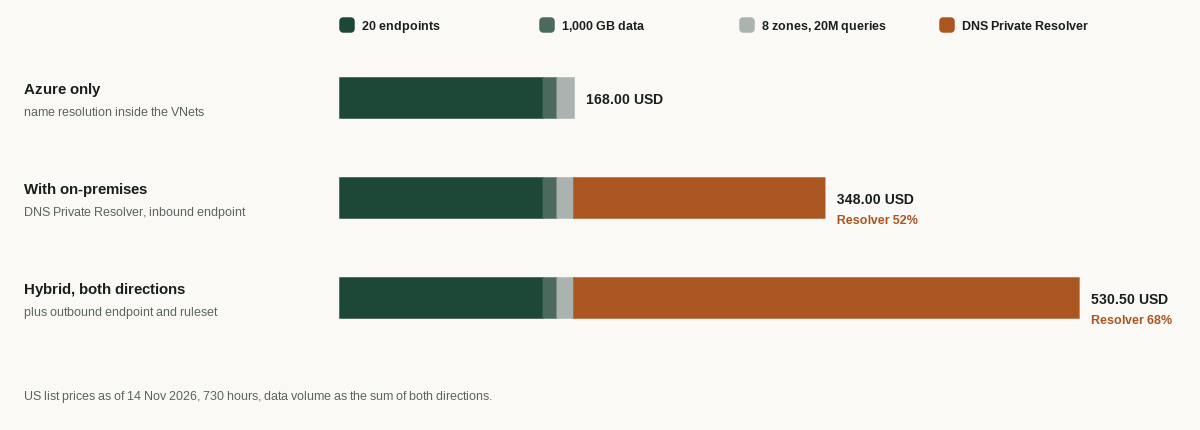
Without on-premises, the environment costs 168 US dollars a month, 146 of them for the endpoints. Once clients on site need to reach the endpoints, the resolver inbound endpoint is added and accounts for 52 percent of the bill. If Azure workloads also need to resolve on-premises names, the outbound endpoint and ruleset take it to 530.50 US dollars, 68 percent of it for the resolver.
One zone per service type, not per endpoint
Each service type has its own privatelink zone, for example privatelink.blob.core.windows.net for blob and privatelink.vaultcore.azure.net for Key Vault. A storage account with blob and files therefore needs two endpoints and two zones. Every further storage account uses the same zones.
Microsoft recommends creating each zone only once and linking it to every VNet that needs it. Zones with the same name in each spoke cost hardly anything, but they require records to be reconciled by hand. At 0.50 US dollars per zone the operational effort weighs more than the price.
The resolver is the biggest fixed item
Queries from on-premises do not reach private DNS zones directly. Microsoft documents two ways to solve this: the DNS Private Resolver as a managed service, or a DNS forwarder in the linked VNet, meaning a VM running DNS or Azure Firewall as a DNS proxy. The forwarder passes queries on to the Azure DNS address 168.63.129.16.
If domain controllers already run in Azure, they can take on this job at no extra cost. Availability, patching and monitoring then sit with your own operations, with the resolver they sit with Microsoft. With few sites and moderate DNS load the numbers usually favour the forwarder, with strict operational requirements the resolver.
A common mistake when forwarding from on-premises: the conditional forwarder has to point to the public zone, database.windows.net, not to privatelink.database.windows.net.
Where data costs grow
Processed data costs 0.01 US dollars per GB inbound and the same outbound. For web apps and Key Vault this hardly matters. Backups, database exports or a data lake that reads several terabytes a day quickly make data the largest item, though. In those cases it is worth comparing with the standard service endpoint, which bills per VNet instead of per GB.
More on this: Standard service endpoint: when it replaces private endpoints and when it does not
Counting your own estate
This Azure Resource Graph query counts all private endpoints by target service and region, including those with manual approval.
resources
| where type =~ 'microsoft.network/privateendpoints'
| extend c = iff(array_length(properties.privateLinkServiceConnections) > 0,
    properties.privateLinkServiceConnections, properties.manualPrivateLinkServiceConnections)
| mv-expand c
| extend ziel = tostring(c.properties.groupIds[0])
| summarize endpunkte = count() by ziel, location
| order by endpunkte desc
Multiplied by 7.30 US dollars, that gives the fixed share for endpoints. The portal shows zones and resolver endpoints under Private DNS zones and DNS Private Resolver.
Decide DNS first
The endpoints themselves are quick to create and cheap. Name resolution is where it gets expensive or error-prone. An architecture review decides where the zones live, whether a resolver or a forwarder answers the queries and which services need a private endpoint at all.
Frequently asked questions
How much does an Azure private endpoint cost per month?
0.01 US dollars per hour, about 7.30 US dollars a month, plus 0.01 US dollars per GB of processed data in each direction. Private DNS zones and, where needed, the DNS Private Resolver come on top.
Do I need a separate DNS zone for every private endpoint?
No. There is one zone per service type, for example one for all blob endpoints. Microsoft recommends creating it once and linking it to every VNet that needs it.
Do I need the DNS Private Resolver?
Only if clients outside the linked VNets, for example on-premises, have to resolve the endpoints. As an alternative, Microsoft documents a DNS forwarder in Azure, such as a VM or Azure Firewall.
Does the classic service endpoint cost anything?
No, according to Microsoft there is no additional cost. The new standard service endpoint costs 0.10 US dollars per VNet per hour.
Sources (as of 14 November 2026)
- Microsoft: Azure Private Link pricing (retrieved 14 Nov 2026)
- Microsoft: Azure DNS pricing including DNS Private Resolver (retrieved 14 Nov 2026)
- Microsoft Learn: Azure Private Endpoint private DNS zone values
- Microsoft Learn: Azure Private Endpoint DNS integration scenarios
- Microsoft Learn: Azure Private Link frequently asked questions