On 3 December 2026 Microsoft raises the cap up to which transactions on Standard SSD are billed. The price per transaction stays the same, the cap doubles for every size. For disks under heavy load, transaction cost therefore doubles, first visible on the December invoice.
The service notification arrived in mid October with the subject “Review changes to Standard SSD managed disk transaction billing”. It lists only the new values. The previous ones are in a Microsoft blog post from 2023, whose archived version from March 2026 allows the comparison.
How Standard SSD bills transactions
Every read or write up to 256 KiB counts as one transaction, larger operations count several times. Microsoft charges 0.002 US dollars per 10,000 transactions, but only up to a cap per hour and disk. Anything above it is free for that hour.
That cap is what changes. A disk that regularly reached it pays up to twice as much from December. A lightly used disk will not notice.
The numbers for selected sizes
| Tier (LRS) | Previous cap per hour | Cap from 3 Dec 2026 | Maximum transaction cost per month |
|---|---|---|---|
| E4 (32 GiB) | 43,400 (about 12 IOPS) | 86,800 (about 24 IOPS) | 6.34 → 12.68 USD |
| E10 (128 GiB) | 147,200 (about 41 IOPS) | 294,400 (about 82 IOPS) | 21.49 → 42.99 USD |
| E15 (256 GiB) | 274,000 (about 76 IOPS) | 548,000 (about 152 IOPS) | 40.00 → 80.01 USD |
| E30 (1 TiB) | 829,200 (about 230 IOPS) | 1,658,400 (about 461 IOPS) | 121.06 → 242.13 USD |
| E50 (4 TiB) | 1,578,400 (about 438 IOPS) | 3,156,800 (about 877 IOPS) | 230.45 → 460.90 USD |
| E80 (32 TiB) | 9,478,400 (about 2,633 IOPS) | 18,956,800 (about 5,266 IOPS) | 1,383.85 → 2,767.70 USD |
Calculated with 730 hours per month and the US list price of 0.002 US dollars per 10,000 transactions. The IOPS values are the hourly average at which the cap is reached, for operations up to 256 KiB. ZRS follows the same pattern with higher caps. Regional prices and agreements may differ.
When Premium SSD is cheaper
Premium SSD does not bill transactions unless paid on-demand bursting is enabled. According to the pricing page, an E10 of 128 GiB costs 9.60 US dollars a month plus transactions, a P10 of the same size a flat 17.92 US dollars. Each average IOPS costs about 0.53 US dollars a month on Standard SSD.
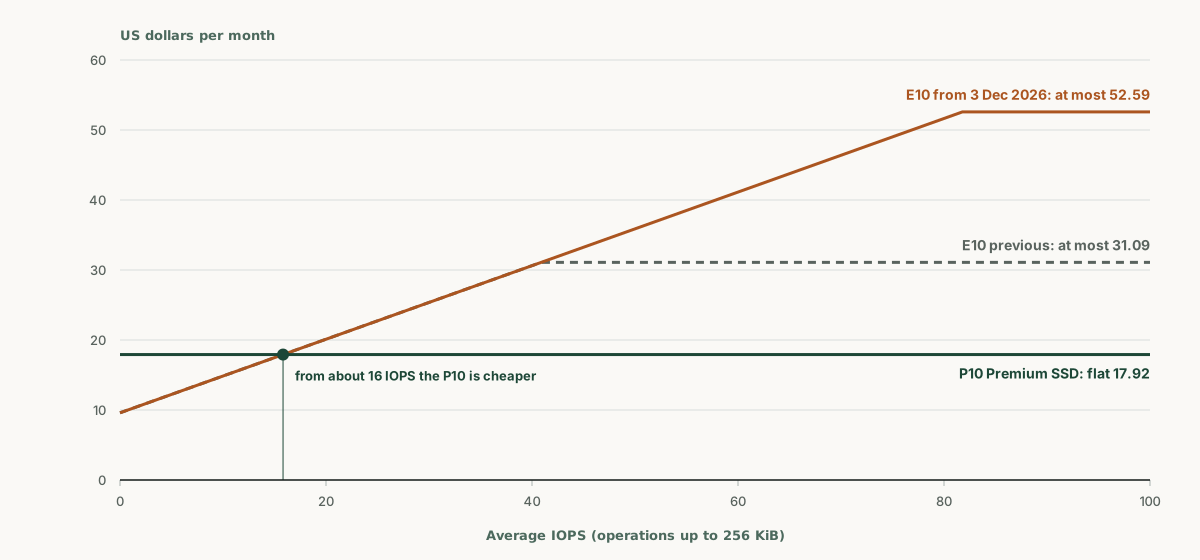
From about 16 IOPS on average, the P10 is already cheaper than the E10 today, regardless of the change. With the new cap, the gap under heavy load grows from about 13 to about 35 US dollars per disk and month. It requires a VM size that supports Premium Storage.
Finding the affected disks
This Azure Resource Graph query lists every attached Standard SSD with size and VM. The size determines the tier, for example 128 GiB for E10.
resources
| where type =~ 'microsoft.compute/disks'
| where sku.name in~ ('StandardSSD_LRS', 'StandardSSD_ZRS')
| where tostring(properties.diskState) != 'Unattached'
| project name, resourceGroup, location, sku = tostring(sku.name),
    sizeGB = toint(properties.diskSizeGB), vm = tostring(managedBy)
| order by sizeGB desc
For load, Azure Monitor shows read and write operations per disk. Look at at least 30 days and compare the hourly average with the old and new cap from the table. Operations above 256 KiB count several times, so with large blocks the number of transactions exceeds the number of operations. In Cost analysis, the Disk Operations meter shows what transactions already cost today.
What I would check before December
- Disks whose transaction cost already reaches the old cap: they pay up to twice as much from December.
- Disks with a sustained load above about 16 IOPS on E10, or comparable load on other tiers: Premium SSD is often cheaper there already.
- Disks with very variable load: Premium SSD v2 bills IOPS and throughput separately and includes 3,000 IOPS at no extra cost, but cannot be used as an OS disk.
- Adjust budgets and cost alerts for December to the new maximum amounts.
Where the cost analysis comes in
Whether a change pays off is decided per disk, based on measured load, VM size and availability requirements. The cost and migration analysis delivers this mapping for your subscriptions, with costs before and after 3 December. Implementation stays with your team or your service provider.
More on this: Azure cost: what a FinOps review typically finds
All dates at a glance: Azure deadline calendar 2026 to 2029
Frequently asked questions
Does the price per transaction on Standard SSD go up?
No. It stays at 0.002 US dollars per 10,000 transactions according to the US price list. What rises is the hourly cap up to which transactions are billed. It doubles for every size.
Which disks are affected?
Standard SSDs whose load exceeded the previous cap. For an E10 it was about 41 IOPS as an hourly average. Lightly used disks keep paying the same.
When will the change show on the invoice?
It applies from 3 December 2026. According to Microsoft, it may already appear on the December 2026 invoice.
Does this also apply to Premium SSD or Standard HDD?
No. Microsoft explicitly names only Standard SSD. Premium SSD does not bill transactions except for paid on-demand bursting, and Standard HDD has its own model.
Sources (as of 30 October 2026)
- Microsoft service notification “Review changes to Standard SSD managed disk transaction billing”, tracking ID MQR7-KK0 (email of 16 Oct 2026, in the Azure portal under Service Health)
- Microsoft: Managed Disks pricing (Standard SSD and Premium SSD, retrieved 30 Oct 2026)
- Microsoft Learn: Standard SSD transactions
- Microsoft Tech Community: Cost saving with Standard SSD Billing Caps (2023, updated 27 Oct 2026)
- Internet Archive: the same post as of 9 Mar 2026 with the previous caps