Anyone replacing Bv1 VMs or planning a new small VM ends up with the second generation of the B-series. It comes in three variants: Bsv2 on Intel, Basv2 on AMD and Bpsv2 on Arm64. Sizes, base performance and credits follow the same pattern in all three, prices do not.
The choice comes down to three questions: what do the size names mean, what do they cost in West Europe, and how long does a VM last under load before Azure throttles it?
Reading the size names
The letters after the vCPU count define memory and base performance. An a stands for AMD, a p for Arm64, and without either letter it is Intel.
| Suffix | Memory per vCPU | Base performance | Example |
|---|---|---|---|
| ts | 0.5 GiB | 20% | B2ts_v2: 2 vCPU, 1 GiB |
| ls | 2 GiB | 30% | B2ls_v2: 2 vCPU, 4 GiB |
| s | 4 GiB | 40% | B2s_v2: 2 vCPU, 8 GiB |
Bsv2 and Basv2 go up to 32 vCPU and 128 GiB, Bpsv2 up to 16 vCPU and 64 GiB. None of the three has a local temp disk, and none supports ephemeral OS disks or nested virtualization. Bpsv2 only runs as a generation 2 VM, Bsv2 and Basv2 also as generation 1.
What 2 vCPU and 8 GiB cost per month
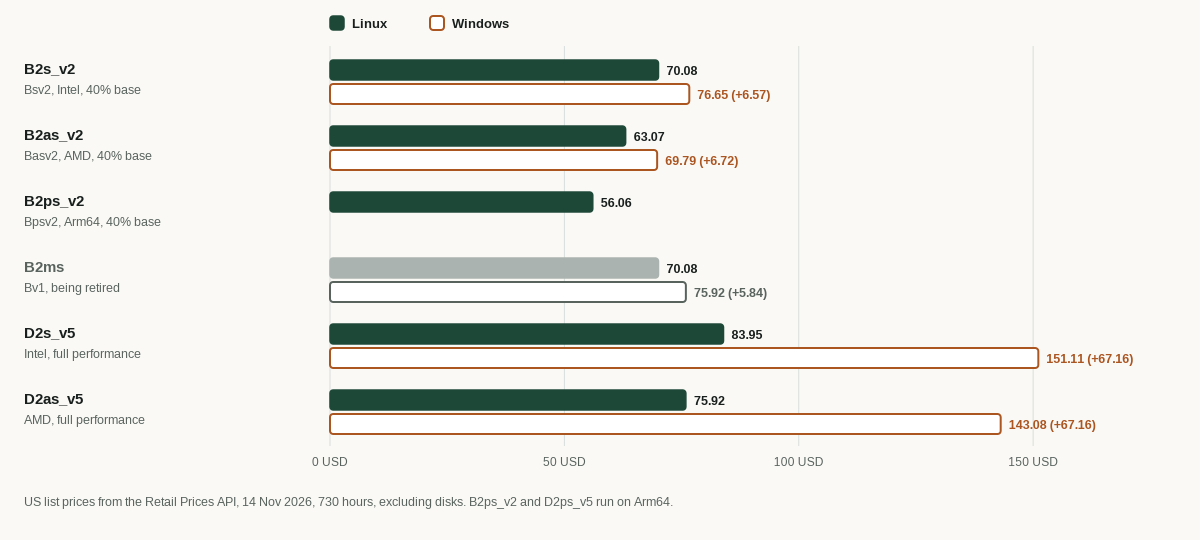
For the same size, Basv2 is 10 percent cheaper than Bsv2 and Bpsv2 about 20 percent. The Arm variant requires an operating system and application built for Arm64, which makes it mainly an option for Linux.
Compared with Bv1, the price barely changes. B2ms and B2s_v2 both cost 70.08 US dollars on Linux, and on Windows the B2s_v2 is 73 cents more.
On Windows the gap to the D-series is large
On Linux, a B2s_v2 is 16.5 percent cheaper than a D2s_v5 of the same size. On Windows the difference is 49 percent. The reason is the Windows surcharge: 6.57 US dollars a month on the B2s_v2 against 67.16 US dollars on the D2s_v5. At four vCPU the ratio holds, a B4s_v2 with Windows costs 153.30 US dollars and a D4s_v5 302.22 US dollars.
For lightly loaded Windows servers such as domain controllers, print servers or jump hosts, the B-series is therefore clearly the cheapest choice. Microsoft does not explain the different surcharge in the price list. With Azure Hybrid Benefit the surcharge disappears anyway, the Linux price applies and the lead shrinks back to about 16 percent.
How long the credits last
A B-series VM earns credits while it runs below its base performance and spends them above it. Microsoft gives the per-minute calculation as base performance times vCPU, minus CPU utilisation times vCPU, divided by 100. For a B2s_v2 with a 40 percent base that means:
- Idle: plus 0.8 credits per minute, 48 per hour. After 24 hours the maximum of 1,152 credits is reached.
- Full load with a full balance: minus 1.2 credits per minute. The VM lasts 16 hours before Azure throttles it to 40 percent.
- 60 percent sustained load: minus 0.4 credits per minute, a full balance lasts 48 hours.
- Freshly created VM: it starts with only 60 credits. Under full load it runs out after 50 minutes.
The last point matters for migrations in particular. A rebuilt Windows VM that installs updates, sets up agents and runs a first antivirus scan after boot can use up its initial credits within the first hour and then feels slower than expected. Azure Monitor shows the balance in the "CPU Credits Remaining" metric.
When the B-series is the wrong choice
- Utilisation averaged over the week sits above the base performance. The balance then drains permanently, and a D size delivers full performance for the extra cost.
- The application needs a local temp disk, for example for a page file on D: or for tempdb.
- Hyper-V or another hypervisor is meant to run inside the VM. None of the three variants supports nested virtualization.
- Performance has to be predictable, for example for load tests or benchmarks. A throttled B-series VM skews every result.
More on this: Replacing Bv1: a six-step runbook
Choosing the variant from measurements
Two measurements decide between Bsv2, Basv2, Bpsv2 and the D-series: average CPU utilisation and the credit history over 30 days. A cost and migration analysis assigns the right size to each VM and calculates the difference with and without Azure Hybrid Benefit. The change itself stays in your hands.
Frequently asked questions
What is the difference between Bsv2 and Basv2?
Bsv2 runs on Intel Xeon processors, Basv2 on AMD EPYC 7763v. Sizes, base performance and credits are identical. In West Europe, Basv2 is 10 percent cheaper for the same size.
Is Bsv2 more expensive than Bv1?
Barely. B2ms and B2s_v2 both cost 70.08 US dollars a month on Linux in West Europe, and on Windows the B2s_v2 is 73 cents more. The main technical difference is the missing temp disk.
How long can a B2s_v2 run at full load?
With a full balance of 1,152 credits, about 16 hours. A newly created VM starts with 60 credits and is throttled to 40 percent after roughly 50 minutes at full load.
Does Bpsv2 support generation 1 VMs?
No. Bpsv2 only supports generation 2 and needs an operating system and applications built for Arm64. Bsv2 and Basv2 support both generations.
Sources (as of 14 November 2026)
- Microsoft Learn: Bsv2-series sizes
- Microsoft Learn: Basv2 size series
- Microsoft Learn: Bpsv2 size series
- Microsoft Learn: B-series CPU credit model
- Microsoft Learn: FAQ Azure VM sizes with no local temporary disk
- Microsoft: Azure Retail Prices API, West Europe region, queried 14 Nov 2026
- Microsoft Learn: Explore Azure Hybrid Benefit for Windows VMs