From 1 December 2026, usage-based billing is set up automatically for new Microsoft 365 Copilot Business licences bought through the Cloud Solution Provider programme (CSP). On top of the fixed price per user, charges for Copilot Credits can then occur, billed through an Azure subscription. The preset is 4,000 credits per user per month.
Microsoft lists a number of countries where the change does not apply for now. Germany is on that list, Austria and Switzerland are not.
Two kinds of cost
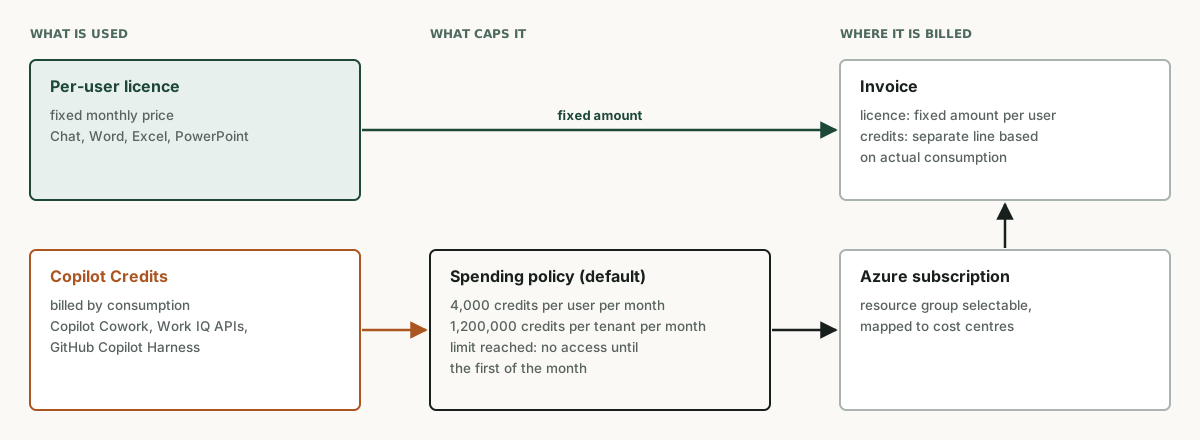
Since September 2026, Microsoft has separated two kinds of Copilot usage. Everyday work in Chat, Word, Excel or PowerPoint is covered by the per-user licence. Tasks that agents carry out on their own over longer periods run on Copilot Credits and are billed by consumption.
For Copilot Business, Microsoft currently lists Copilot Cowork, the Work IQ APIs and GitHub Copilot Harness. More services are to follow.
What changes on 1 December
Until now, a CSP partner had to set up an Azure subscription and create a spending policy in the Microsoft 365 admin center before usage-based billing worked. From 1 December, Partner Center does this at purchase: it creates the Azure plan, subscription and resource group if they are missing and adds a default policy for the whole tenant. This is triggered by:
- a new purchase of an eligible Copilot Business licence, including bundles with Business Basic, Business Standard or Business Premium,
- additional licences added in the Partner Center portal,
- a trial converting to a paid licence.
Existing subscriptions do not change. If the tenant already has a spending policy, Partner Center does not create a second one. Microsoft 365 Copilot for enterprise is not affected, and neither are education, nonprofit and government offers.
What the defaults mean
The default policy allows 4,000 credits per user per month and 1,200,000 credits for the tenant. Whichever limit is reached first applies. A user who reaches the limit loses access to the affected services for the rest of the month, and the count resets on the first of the month.
The price per credit is in the price list. A worked example on Microsoft Learn uses 0.01 US dollars per credit. At that rate, the caps are:
- 4,000 credits per user: up to 40 US dollars per user per month on top of the licence
- 100 users: up to 400,000 credits or 4,000 US dollars a month
- Tenant limit of 1,200,000 credits: up to 12,000 US dollars a month
These are caps, not forecasts. Actual cost depends on who uses the services and how heavily. Copilot Business is limited to 300 users, and 300 times 4,000 equals the tenant limit exactly. In practice the per-user limit is the one that binds. For an estimate, Microsoft offers the Copilot Credit Estimator.
Keeping cost under control
- Review the default policy in the Microsoft 365 admin center under Copilot, Cost management, and add policies for specific groups where needed. Individual users can currently only be assigned through security groups.
- Set up threshold notifications for administrators and users.
- Check the “Auto-apply new services” setting. It is on by default and adds future services to the policy automatically.
- Give finance reader roles so consumption reports can be reviewed without change permissions.
- Map the cost to your existing cost centres through the Azure subscription and resource group. Global and billing administrators can choose a separate Azure subscription per policy.
Microsoft’s documentation is not consistent on minimum limits and on switching usage off. The admin center documentation requires at least 2,000 credits per user per month, while the Partner Center documentation states at least 4,000 for the default policy. To stop usage, it describes a limit of zero in one place and deleting the policy in another. Usage already incurred has to be paid either way. The Partner Center documentation is marked as preliminary. Before 1 December, confirm what will actually apply.
What else happens on 1 December
On the same day Microsoft introduces new Microsoft 365 Copilot and Copilot Business offers that can be bought without a Microsoft 365 base licence, at the same price. Since 16 October the existing offers carry the suffix “(add-on)”, and from 1 December they are no longer available for new purchases in CSP. Existing subscriptions continue and can be renewed and resized. The capabilities do not change.
What to settle before buying
- Who owns the spending policy, IT or finance?
- Which users actually need Cowork or other usage-based services?
- Which Azure subscription and cost centre should carry the cost?
- Which limit is acceptable to start with, and who approves increases?
Bringing credits into budget planning
Copilot Credits appear in the same Azure billing as the rest of your cloud consumption, as a separate line next to the licence. A cost analysis includes them in budget planning and proposes policies and limits that fit actual usage. Your team then sets up the policies itself.
More on this: Azure cost: what a FinOps review typically finds
All dates at a glance: Azure deadline calendar 2026 to 2029
Frequently asked questions
Does the change affect existing Copilot Business licences?
No. From 1 December 2026 it applies to new purchases in CSP, to licences added in the Partner Center portal and to converted trials. Existing subscriptions stay as they are.
Does the change apply in Austria?
Austria is not on the list of countries where the change is not yet available. That list includes Germany, France, Italy, the Netherlands, Belgium, Poland and Spain, among others.
What happens when a user reaches the limit?
The user loses access to the usage-based services for the rest of the month and can request more credits. The count resets on the first of the month.
Is there a charge if nobody uses the services?
No. Billing is based on actual consumption. The limits only cap how much can be charged at most.
Does this also apply to Microsoft 365 Copilot for enterprise?
No. The change only covers Copilot Business. For enterprise customers, Microsoft states that usage-based services stay off until an administrator creates a spending policy.
Sources (as of 23 October 2026)
- Partner Center: Usage-based billing is default on for new Microsoft 365 Copilot Business licenses starting December 1, 2026 (1 Oct 2026, updated 14 Oct 2026)
- Microsoft Learn: Usage-based billing for Microsoft 365 Copilot Business in Partner Center (marked as preliminary)
- Partner Center: Copilot offers and name updates (14 Oct 2026)
- Microsoft Learn: Usage-based billing and cost management for Copilot Credits
- Microsoft Learn: Managing AI experiences enabled by usage-based billing
- Microsoft Learn: Copilot Credit P3 (worked example at 0.01 US dollars per credit)
- Microsoft Tech Community: Evolution of the Copilot pricing model (25 Sep 2026)